K–9 · English / Mandarin / Cantonese
Until your child can explain why that step needs division
One-on-one K–9 math tutoring in Metro Vancouver. Not worksheets and memorized formulas — Socratic questioning and a step-by-step deconstruction method that takes a word problem from "I do not get it" to "here is my reasoning."
- Teaching K–9 math since 2018
- Master's in Educational Psychology, UVic
- Assessment before enrolment
What this is not
No stack of worksheets to grind through
One problem, taken apart until your child can justify every step
No memorized solution templates
Full written reasoning, so the thinking is visible
No three-session cram before a test
A fixed weekly rhythm, planned by term
No single textbook applied to every child
Singapore Math, Hong Kong materials and BC curriculum practice, chosen against the actual gap
Why "can explain it" beats "got it right"
When a child gets a question wrong, it is often not the arithmetic — it is that they never worked out what the question was asking. Drilling does not close that gap; the volume goes up and the gap stays exactly where it was. In session I keep asking: what do we know at this step, and what do we need next? — until the child can narrate the whole path in their own words. A child who can do that does not panic when the next problem looks unfamiliar.
What parents say
From parents of current students. By privacy convention, only city and grade are given.
Richmond · Grade 4 parent「He tells me Ms. Chu’s class is his favourite, and looks forward to it every week」
Getting him to sit down for math used to be a battle. Since starting with Ms. Chu his attitude has completely changed — he keeps telling me hers is the class he likes best. She explains clearly, and she knows how to get a child engaged; math that used to be dull became something he wants to do. Seeing him go to math willingly and happily is an enormous relief as a parent.
Vancouver · Grade 5 parent「He never understood the other math tutors. With Ms. Chu it clicked straight away」
He had been with other math tutors before, but always said the sessions were too abstract and he still got stuck on the problems. After switching to Ms. Chu, he says he understands. She is very good at breaking complex ideas down into something concrete — genuinely teaching to the child in front of her.
The deconstruction method, step by step
Every multi-step word problem goes through the same routine. What the child learns is the routine, not the answer to that one question.
- 01
Break down what is given
Turn a long paragraph or a diagram into separate, concrete pieces of information. No calculating yet — first, get clear on what the question actually said.
- 02
Build the logical bridge
Questions instead of explanations: "What do we know now?" "What do we need next?" The child states the path. I do not hand it to them.
- 03
Write it out properly
The full derivation goes on paper. Getting the answer is not enough — the reasoning has to be traceable. This is also what earns method marks in the senior grades.

Scroll through one: how a word problem comes apart
This is the routine used in session. What the child learns is the routine, not the answer to this one question.
↓ Scroll to work through it
Ming gives stickers to 3 friends, 4 each, and has 5 left over. How many did he start with?
Three formats
The teaching method does not change. Pace, interaction, and cost do. I will recommend one after the assessment.

In person, one-on-one
Full attention on one child for the whole hour
Children with a clearly identified gap, or who need room to think at their own pace.

In person, one-on-two
Company for the child, while the work stays their own
Pair up with a friend you already know or a sibling — or ask, and a suitable partner can be matched by learning pace and available times.
Online
Available anywhere. The option for families outside Richmond
Families elsewhere in Metro Vancouver, or with schedules that will not accommodate a fixed library slot.
Children who learn at a different pace
Attention patterns and thinking styles differ from child to child. Alongside standard tutoring, I have years of experience supporting children who need more patience, more structure, or a different rhythm — including children who are easily distracted, highly sensitive, or who simply think in their own way.
High structure, clear expectations
Session tasks broken into small, clearly bounded modules with a steady rhythm — which reduces fatigue and the anxiety of not knowing how much longer this will go on.
Multi-sensory and concrete
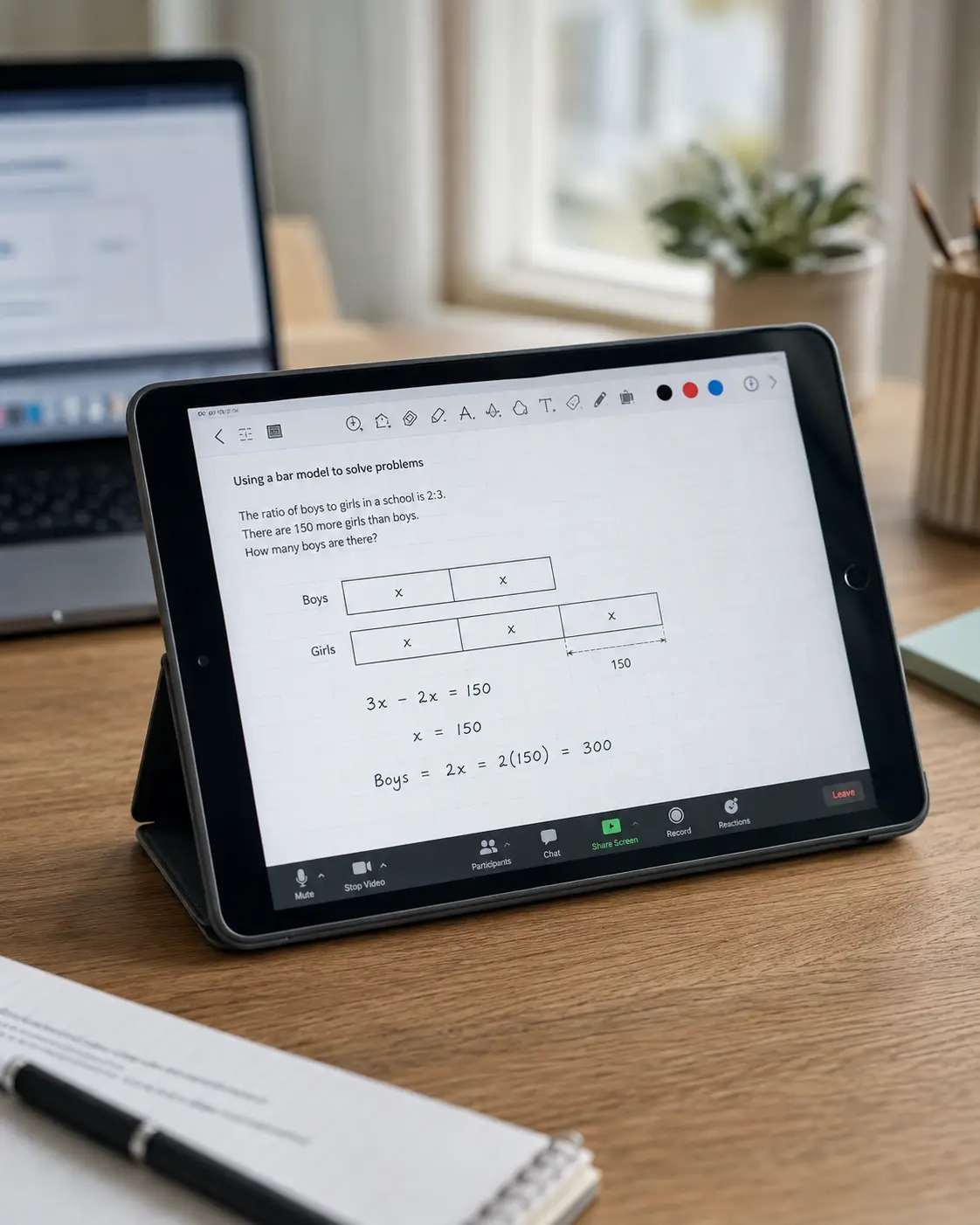
Heavy use of diagrams and back-and-forth questioning, so a child whose attention drifts always has something to participate in rather than a lecture to sit through.
Emotional safety first
Children are allowed to think at their own speed. Before math confidence can be rebuilt, the association between "math class" and "being told I am wrong" has to come apart.

University of VictoriaMaster's in Educational Psychology
Focused on K–9: building the underlying logic, developing comprehension of word problems, and getting solution steps written properly.
About the instructor →Materials
No single workbook. Resources are combined against the specific gap and the stage the child is at.
Singapore Math
The CPA progression (Concrete–Pictorial–Abstract). Strong for word-problem modelling — it moves a child from reading the bar model to writing the equation.
Hong Kong math materials
Borrowed for their demanding computation practice and strict expectations around solution steps. Good foundations for algebra and geometry.
BC curriculum and extension problems
Aligned to what the child is actually doing at school (BC math curriculum), plus selected extension problems. No drilling for the sake of volume.
Concrete first, then abstract
The first stage of Singapore Math’s CPA progression is the concrete one — explaining a slippery idea with something you can actually handle. Gears for ratio and multiples; a balance for why both sides of an equation have to match. A child who has seen it work does not have to memorise the symbol version.
Newton’s cradle · conservation
Gears · ratio 2:1
Balance · both sides
Circle · periodicity
How it starts
A clear process is a precondition for the teaching to work.
- 01
Send an email
Your child's grade, where they are stuck, and what you want solved. A paragraph or two is enough.
- 02
One-hour assessment
Required before any plan is made. It locates the knowledge gaps and the breaks in reasoning. It is not a test, and your child does not need to prepare.
- 03
Plan and quote
Recommended format, weekly frequency, session length, and fees — set out in one go.
- 04
Fixed schedule, notes after each session
At least one session a week, at a fixed time. A short written progress note follows every session.

Start with an assessment, then decide
Every new student begins with a one-hour thinking and skills assessment. Afterwards you get a written picture of where the gap actually is, what pace your child needs, and how sessions should be scheduled. You decide from there — and if I am not the right fit, I will say so.
Sessions and communication in English, Mandarin, or Cantonese. · [email protected]